Showing posts with label religion. Show all posts

Saturday, February 22, 2014

Quote #156: Thomas Jefferson on federalism and the free exercise of religion

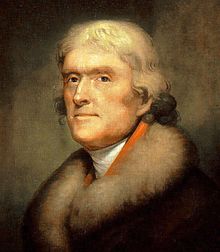
"In matters of religion, I have considered that its free exercise is placed by the constitution independent of the powers of the general government. I have therefore undertaken, on no occasion, to prescribe the religious exercises suited to it; but have left them, as the constitution found them, under the direction and discipline of state or church authorities acknowledged by the several religious societies."

- Second Inaugural Address, March 4, 1805.

Monday, June 4, 2012

Quote #151: man as a social animal

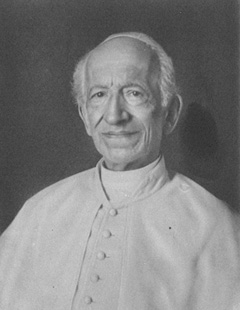
"And indeed nature, or rather God Who is the author of nature, wills that man should live in a civil society; and this clearly shown both by the faculty of language, the greatest medium of intercourse, and by numerous innate desires of the mind, and the many necessary things, and things of great importance, which men isolated cannot procure, but which they can procure when joined and associated with others."

- Pope Leo XIII, Diuturnum (On Civil Government) (1881).

Thursday, September 22, 2011

Quote #144: Archbishop Oscar Romero on hope


The words of a great martyr for the faith and
for his people who spoke about hope in the 
face of what appears to be insurmountable 
problems:

"Hope is not resignation; it is a commitment 
to continue to struggle even when things seem 
to warrant surrender, when hope flares, it 
allows human beings to overcome monstrous 
difficulties.  It allows people to defy common 
sense and confound strategists.  Hope 
experienced in the extreme, like faith and love, is miraculous."

Servant of God Oscar Romero, martyr, ora pro nobis!

Sunday, June 5, 2011

Quote #140: dissenting religion and the push for American Independence

From the great English statesman Edmund Burke (1729-1797) comes this analysis of the role that dissenting religion played in the American commitment to liberty at the time leading up to our Revolution:

Religion, always a principle of energy, in this new people is no way worn out or impaired; and their mode of professing it is also one main cause of this free spirit. The people are Protestants; and of that kind which is the most adverse to all implicit submission of mind and opinion. This is a persuasion not only favourable to liberty, but built upon it. I do not think, Sir, that the reason of this averseness in the dissenting churches, from all that looks like absolute government, is so much to be sought in their religious tenets, as in their history. Every one knows that the Roman Catholic religion is at least coeval with most of the governments where it prevails; that it has generally gone hand in hand with them, and received great favour and every kind of support from authority. The Church of England too was formed from her cradle under the nursing care of regular government. But the dissenting interests have sprung up in direct opposition to all the ordinary powers of the world; and could justify that opposition only on a strong claim to natural liberty. Their very existence depended on the powerful and unremitted assertion of that claim. All Protestantism, even the most cold and passive, is a sort of dissent. But the religion most prevalent in our northern colonies is a refinement on the principle of resistance; it is the dissidence of dissent, and the Protestantism of the Protestant religion. This religion, under a variety of denominations agreeing in nothing but in the communion of the spirit of liberty, is predominant in most of the northern provinces; where the Church of England, notwithstanding its legal rights, is in reality no more than a sort of private sect, not composing most probably the tenth of the people. The colonists left England when this spirit was high, and in the emigrants was the highest of all; and even that stream of foreigners, which has been constantly flowing into these colonies, has, for the greatest part, been composed of dissenters from the establishments of their several countries, and have brought with them a temper and character far from alien to that of the people with whom they mixed.
- Speech on Conciliation with the Colonies, March 22, 1775.

Friday, November 12, 2010

Quote #128: on the need for religion in society

"The principle of liberty and equality, if coupled with mere selfishness, will make men only devils, each trying to be independent that he may fight only for his own interest. And here is the need of religion and its power, to bring in the principle of benevolence and love to men."

- John Randolph of Roanoke (1733-1833), Congressman and leader of the National Republicans Party.

Wednesday, March 17, 2010

Quote CIV


"A little philosophy inclineth a man's mind to atheism, but depth in philosophy bringeth men's minds about to religion."


-Sir Francis Bacon

Thursday, March 11, 2010

Quote Number 100


Bringin' it back...

"The law of the Lord is perfect, converting the soul; the testimony of the Lord is sure, making wise the simple; the statutes of the Lord are right, rejoicing the heart; the commandment of the Lord is pure, enlightening the eyes; the fear of the Lord is clean, enduring forever; the judgements of the Lord are true and righteous altogether; more to be desired are they than gold, yea, than much fine gold; sweeter also than honey and the honeycomb. Moreover, by them your servant is warned, and in jeeping them there is great reward."

Psalm 19:7-11 (New King James Version)

Friday, February 12, 2010

Quote #98: on living in the end times

"Although the early church say the end of the world as imminent, why should we reenter that frame of mind, now that we know that the world was not about to end? Well, the New Testament invites us to see eternity as continually intersecting -- literally, cutting across -- time. This is a synchronic, not a diachronic, faith. We are created now, at every now. Christ comes now; the Incarnation is now. The great judgment is now. 'The accomplishment of everything impends' (1 Peter 4.7). Christ brought his reign with him. It is both present and to come."
--Garry Wills, The Rosary (Viking: 2005), pg. 20.

Friday, November 20, 2009

Quote #81: on revenge

"Giving up our desire to take revenge is a hard sacrifice, perhaps the hardest, which Christ requires of us.  For our whole human nature cries out for vengence against our enemies.  The desire for revenge is stronger in our human blood than any other desire.  But - and we know it - we can no longer take revenge.  If my enemy stands there before my eyes, and I am overcome by the obsession to finally be able to take revenge, then Jesus Christ stands at once behind my enemy and entreats me:  do not lift up your hand, but leave vengence to me; I will take it."

- Dietrich Bonhoeffer (1906-1945), Christ's Love and Our Enemies (1938).

Wednesday, October 7, 2009

Quote #74: the meaning of Jesus' birth

"The birth of Jesus provides our entrance into the reality and meaning of creation: this is the world of the Father revealed by Jesus. Jesus shows us that the creation is something to be lived, not just looked at, and the way he did it becomes the way we do it."

- Eugene H. Peterson, Christ Plays in Ten Thousand Places (Eerdmans: 2005), pg. 137

Sunday, September 6, 2009

Quote #47: on the Lord's advent

From the Old Testament reading assigned for today in the Roman Catholic lectionary:

"Say to them that are of a fearful heart, Be strong, fear not: behold, your God will come with vengeance, with the recompense of God; he will come and save you. Then the eyes of the blind shall be opened, and the ears of the deaf shall be unstopped. Then shall the lame man leap as a hart, and the tongue of the dumb shall sing; for in the wilderness shall waters break out, and streams in the desert. And the glowing sand shall become a pool, and the thirsty ground springs of water: in the habitation of jackals, where they lay, shall be grass with reeds and rushes."

- Isaiah 35.4-7 (American Standard Version).

Quote #46: on redemption

"Wherein is it possible for us, wicked and impious creatures, to be justified, except in the only Son of God? O sweet reconciliation! O untraceable ministry! O unlooked-for blessing! that the wickedness of many should be hidden in one godly and righteous man, and the righteousness of one justify a host of sinners!"

- St. Justin Martyr (100 - 165 A.D.), early Christian theologian, Roman philosopher and martyr for the faith.

Wednesday, April 8, 2009

Quote #39

"In order to advance a principle of freedom, and in order not to threaten the religious establishments of the several states, the founders did a historically unprecedented thing. In the first provision of the First Amendment, they declared that the national government abdicated control of religious brlief and practice. To be sure, this was a matter of practical politics as well as principle. Given the competing Protestant denominations of the time, it was unthinkable that the founders would establish one as the national religion. But practical politics can also be in the service of principle." -- Richard John Neuhaus, American Babylon, pg. 39.

Wednesday, April 1, 2009

Quote #37

"The principle reason for performing exterior penance is to secure three effects:
1. To make satisfaction for past sins;
2. To overcome oneself, that is, to make our sensual nature obey reason, and to bring all of our lower faculties into greater subjection to the higher;
3. To obtain some grace or gift that one earnestly desires. Thus it may be that one wants a deep sorrow for sin, or tears, either because of his sins or because of the pains and sufferigns of Christ our Lord; or he may want the solution of some doubt that is in his mind." -- St. Ignatius Loyola, Spiritual Exercises.

Saturday, March 28, 2009

Quote #35

Such being the impressions under which I have, in obedience to the public summons, repaired to the present station, it would be peculiarly improper to omit in this first official act my fervent supplications to that Almighty Being who rules over the universe, who presides in the councils of nations, and whose providential aids can supply every human defect, that His benediction may consecrate to the liberties and happiness of the people of the United States a Government instituted by themselves for these essential purposes, and may enable every instrument employed in its administration to execute with success the functions allotted to his charge. In tendering this homage to the Great Author of every public and private good, I assure myself that it expresses your sentiments not less than my own, nor those of my fellow-citizens at large less than either. No people can be bound to acknowledge and adore the Invisible Hand which conducts the affairs of men more than those of the United States. Every step by which they have advanced to the character of an independent nation seems to have been distinguished by some token of providential agency; and in the important revolution just accomplished in the system of their united government the tranquil deliberations and voluntary consent of so many distinct communities from which the event has resulted can not be compared with the means by which most governments have been established without some return of pious gratitude, along with an humble anticipation of the future blessings which the past seem to presage. These reflections, arising out of the present crisis, have forced themselves too strongly on my mind to be suppressed. You will join with me, I trust, in thinking that there are none under the influence of which the proceedings of a new and free government can more auspiciously commence.
--President George Washington, First Inaugural Address (1789).

Friday, February 6, 2009

Quote #XXXI

"Facts are stubborn things; and whatever may be our wishes, our inclinations, or the dictates of our passion, they cannot alter the state of facts and evidence." -- John Adams, American founding father and second president of the United States.
Monday, September 1, 2008

Quote No. X

"civilization is confronted with militant Mahommedanism. The forces of progress clash with those of reaction. The religion of blood and war is face to face with that of peace. Luckily the religion of peace is usually the better armed."

Winston Churchill, The Story of the Malakand Field Force

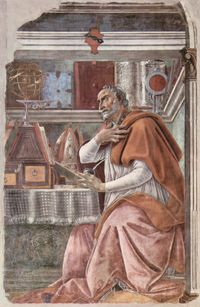
St. Augustine (by Sandro Botticelli)

St. Ignatius Loyola (by Francisco Zurbaran)

Benjamin Rush (by Charles Willson Peale)

Patrick Henry at the Virginia House of Burgesses (by Henry Rothermel)

Edmund Burke (by Sir Joshua Reynolds)

Samuel Adams (by John Singleton Copley)

Alexander Hamilton (by John Trumbull)