Showing posts with label good government. Show all posts

Saturday, February 22, 2014

Quote #156: Thomas Jefferson on federalism and the free exercise of religion

"In matters of religion, I have considered that its free exercise is placed by the constitution independent of the powers of the general government. I have therefore undertaken, on no occasion, to prescribe the religious exercises suited to it; but have left them, as the constitution found them, under the direction and discipline of state or church authorities acknowledged by the several religious societies."

- Second Inaugural Address, March 4, 1805.

Tuesday, January 3, 2012

Quote #146: true and false equality

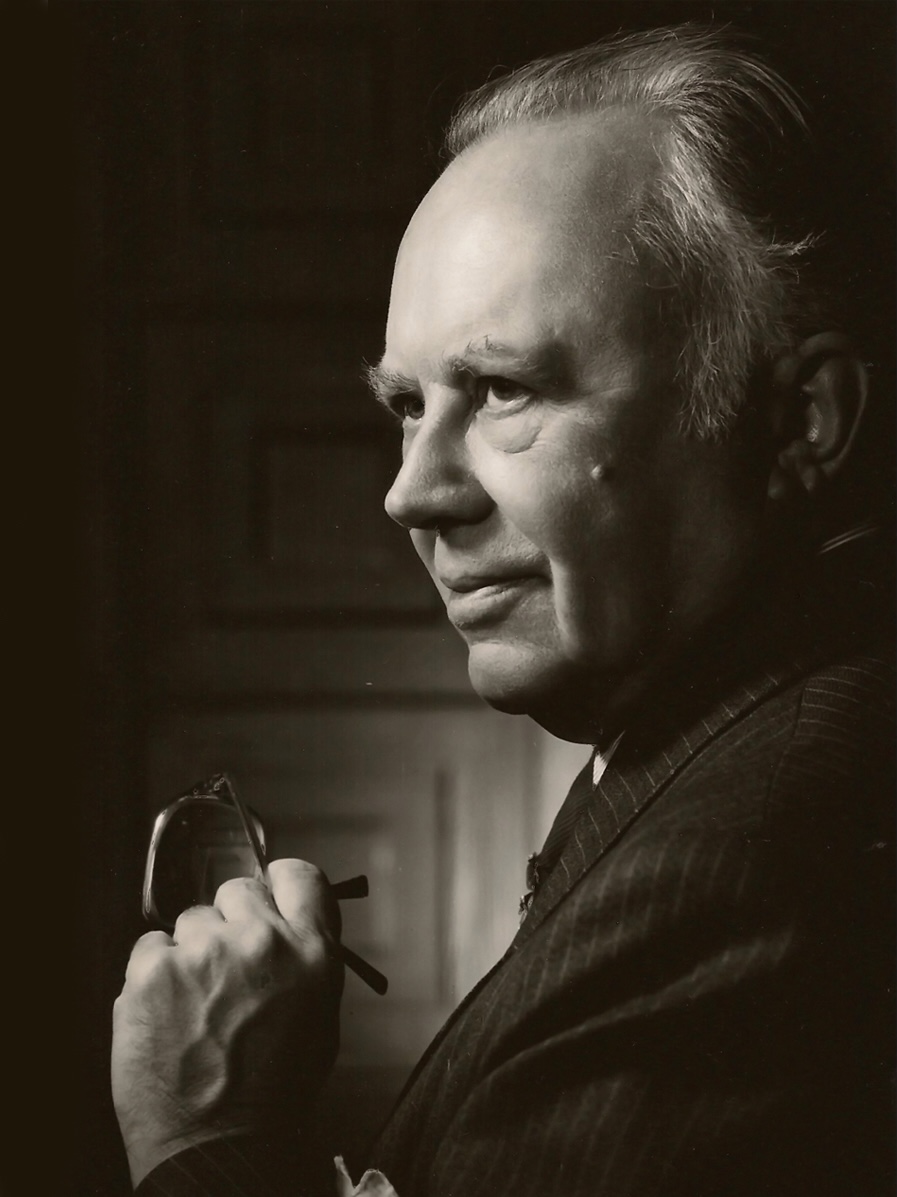
"The only true forms of equality are equality at the Last Judgment and equality before a just court of law; all other attempts at levelling must lead, at best, to social stagnation." 


- Russell Kirk (1918-1994), American writer and conservative theorist.

Sunday, August 14, 2011

Quote #142: Natural law and the nature of government

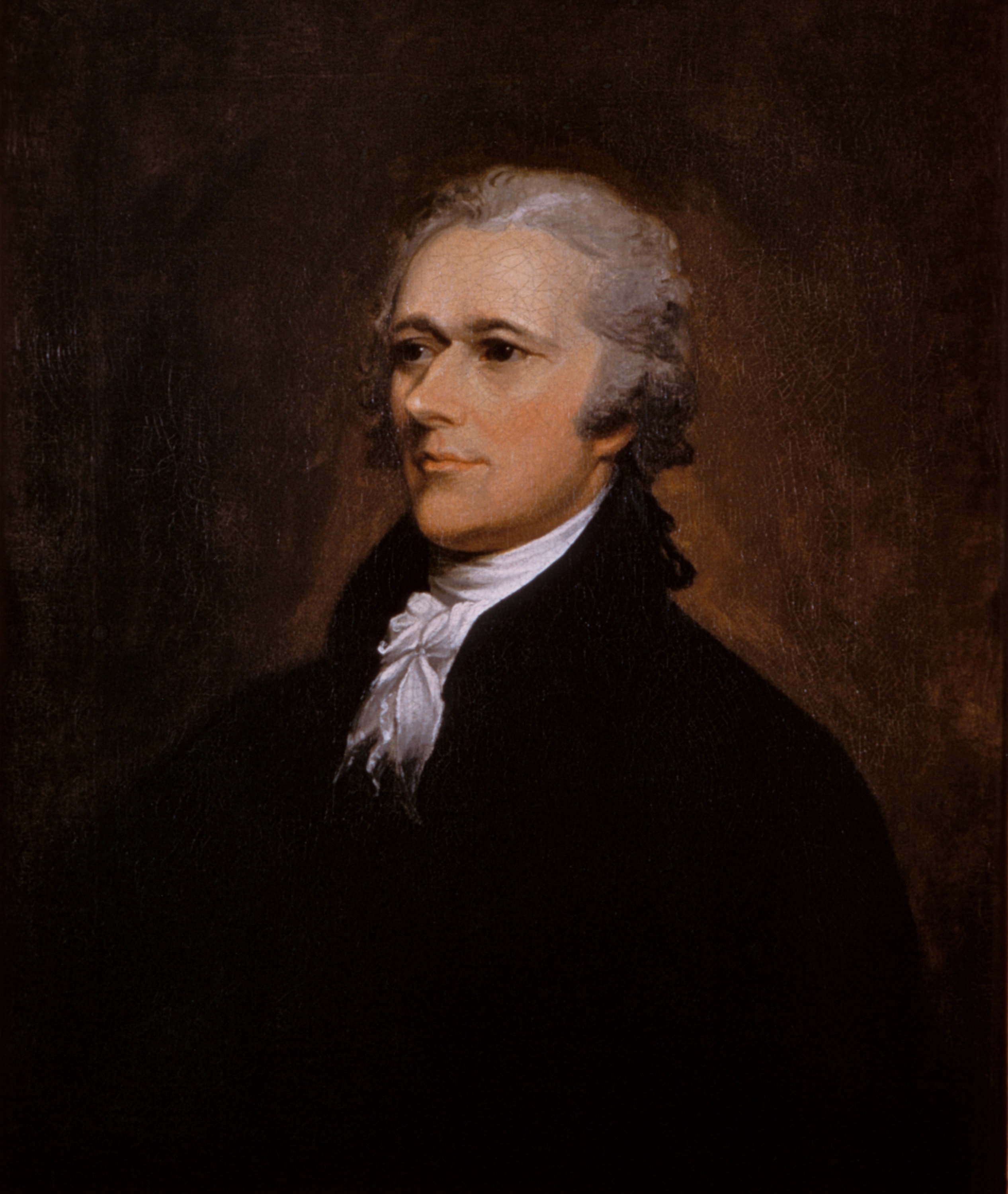
"Good and wise men, in all ages [...] have supposed that the Deity, from the relations we stand in to Himself and to each other, has constituted an eternal and immutable law, which is indispensably obligatory upon all mankind, prior to any human institution whatever.This is what is called the law of nature, “which, being coeval with mankind, and dictated by God himself, is, of course, superior in obligations to any other. It is binding over all the globe, in all countries, and at all times. No human laws are of any validity, if contrary to this; and such of them as are valid derive all their authority, mediately or immediately, from this original.”—Blackstone.

Upon this law depend the natural rights of mankind: the Supreme Being gave existence to man, together with the means of preserving and beautifying that existence. He endowed him with rational faculties, by the help of which to discern and pursue such things as were consistent with his duty and interest; and invested him with an inviolable right to personal liberty and personal safety.
Hence, in a state of nature, no man had any moral power to deprive another of his life, limbs, property, or liberty; nor the least authority to command or exact obedience from him, except that which arose from the ties of consanguinity.

Hence, also, the origin of all civil government, justly established, must be a voluntary compact between the rulers and the ruled, and must be liable to such limitations as are necessary for the security of the absolute rights of the latter; for what original title can any man, or set of men, have to govern others, except their own consent? To usurp dominion over a people in their own despite, or to grasp at a more extensive power than they are willing to intrust, is to violate that law of nature which gives every man a right to his personal liberty, and can therefore confer no obligation to obedience.
“The principal aim of society is to protect individuals in the enjoyment of those absolute rights which were vested in them by the immutable laws of nature, but which could not be preserved in peace without that mutual assistance and intercourse which is gained by the institution of friendly and social communities. Hence it follows, that the first and primary end of human laws is to maintain and regulate these absolute rights of individuals.”—Blackstone."

- Alexander Hamilton (1755-1804), American founding father, The Farmer Refuted (1775).

Sunday, April 3, 2011

Quote #136: On protecting our democratic republic

We should be unfaithful to ourselves if we should ever lose sight of the danger to our liberties if anything partial or extraneous should infect the purity of our free, fair, virtuous, and independent elections. If an election is to be determined by a majority of a single vote, and that can be procured by a party through artifice or corruption, the Government may be the choice of a party for its own ends, not of the nation for the national good. If that solitary suffrage can be obtained by foreign nations by flattery or menaces, by fraud or violence, by terror, intrigue, or venality, the Government may not be the choice of the American people, but of foreign nations. It may be foreign nations who govern us, and not we, the people, who govern ourselves; and candid men will acknowledge that in such cases choice would have little advantage to boast of over lot or chance.
- John Adams (1735-1826), second president of the United States,
Inaugural Address (1797).

Saturday, November 13, 2010

Quote #129: the problem with the religious right

"Adherents of the new religious right reject the separation of politics and religion, but they bring no spiritual insights to politics."

- Christopher Lasch (1931-1994), American historian and social critic.

Saturday, March 20, 2010

Quote CV


"True law is right reason in agreement with nature; it is of universal application, unchanging and everlasting; it summons to duty by its commands and averts from wrongdoing by its prohibitions."

-Marcus Tullius Cicero (106 B.C.-43 B.C.)

Sunday, September 20, 2009

Quote #66: on justice and leadership

Sage advice from the pre-Christian Jewish tradition on the need for those charged with leadership in the community to seek both justice and holiness:
Love justice, you rulers of the earth; set your mind upon the Lord in the right way, and seek him in singleness of heart; for he is to be found by those who trust him without question, and he makes himself known to those who never doubt him. Dishonest thinking cuts people off from God, and if fools like liberties with his power he shows them up for what they are. Wisdom will not enter a shifty soul, nor make her home in a body that is mortgaged to sin. This holy spirit of discipline will shun falsehood; she cannot stay in the presence of unreason, and will withdraw at the approach of injustice.
- Wisdom of Solomon 1.1-5 (circa 2nd century B.C.) (Revised English Bible translation).
Saturday, September 12, 2009

Quote #62: on good government


"A good government implies two things; first, fidelity to the objects of the government; secondly, a knowledge of the means, by which those objects can be best attained."

- Jospeh Story (1779-1845), Associate Justice of the United States Supreme Court.

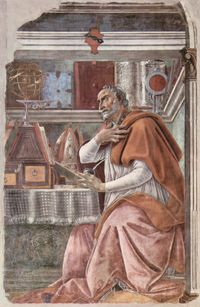
St. Augustine (by Sandro Botticelli)

St. Ignatius Loyola (by Francisco Zurbaran)

Benjamin Rush (by Charles Willson Peale)

Patrick Henry at the Virginia House of Burgesses (by Henry Rothermel)

Edmund Burke (by Sir Joshua Reynolds)

Samuel Adams (by John Singleton Copley)

Alexander Hamilton (by John Trumbull)